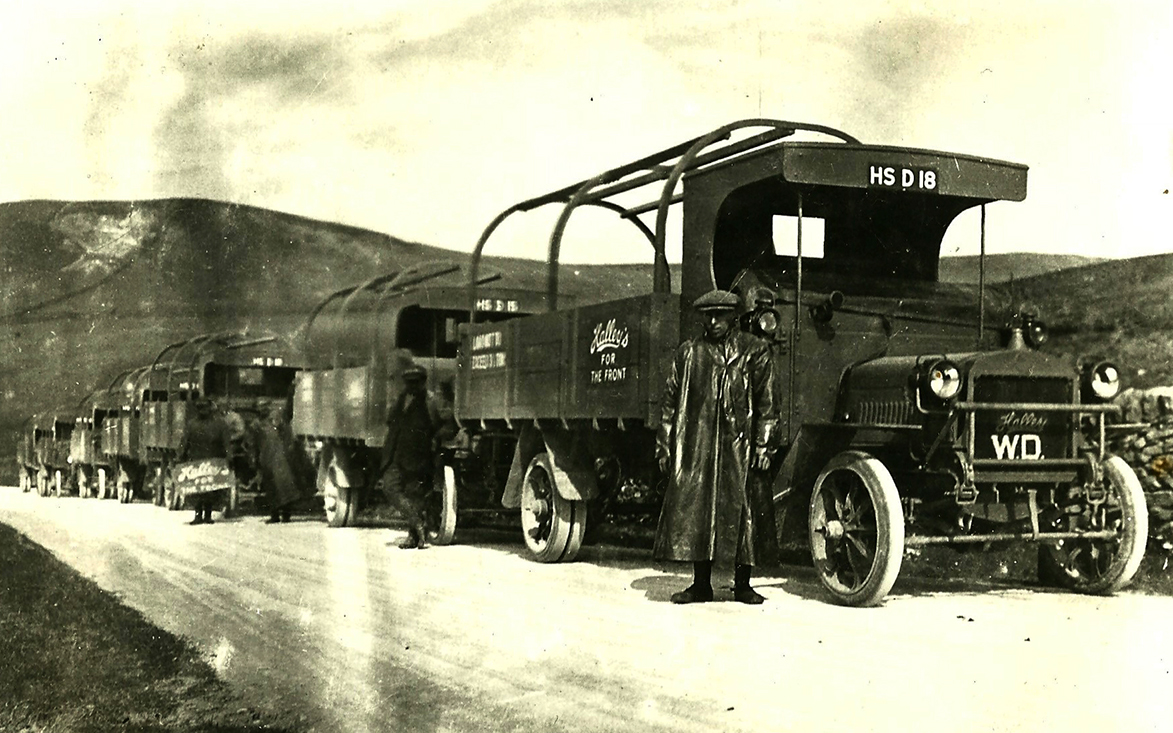
 The
49th Division (Territorial
Force) mobilised on 5th
August 1914 and concentrated in the Doncaster, Yorkshire area. Nine days
later, the Central Divisions, which included 49th
Division, were ordered to establish an Army Service Corps Mechanical
Transport Company.
The
49th Division (Territorial
Force) mobilised on 5th
August 1914 and concentrated in the Doncaster, Yorkshire area. Nine days
later, the Central Divisions, which included 49th
Division, were ordered to establish an Army Service Corps Mechanical
Transport Company.
Designated the West Riding Divisional
Mechanical Transport Supply Column, the company was formed under command
of Captain HV Kitson, from 2nd
Brigade Coy ASC, West Riding Division. Immediately adverts were placed in
local newspapers to find recruits with experience of motor vehicles,
whether as mechanics or drivers. By the 22nd,
100 men had presented themselves and after examination of their
qualifications and a medical, eighty were enlisted into the Territorial
Force.
With no available accommodation, a private
paddock was borrowed in Doncaster, tents obtained from Ordnance and
cooking utensils purchased. Meals were provided by Capt Kitson’s old
company. Within three weeks of the adverts all 320 men required to
complete Establishment had been enlisted. Three months later, all their
clothing and equipment needed had finally been obtained.
An MT Coy needs lorries and, with none
available from the War Office, twenty-one locally impressed vehicles were
hired by the 21st August.
Combined hire charges were £63 [£5,075 in 2021] per day with each owner
paying their running costs. These were presumably in poor condition as the
War Office, who held a census of all the suitable lorries they could
impress, was rapidly running out of available lorries in suitable
condition.
The Army Service Corps Reception Depot at
Kensington Barracks, West London, held a list of companies with suitable
vehicles and also the lorry maker’s agents. When mobilisation was ordered
they visited each agent and obtained a list of their customers and what
vehicles they had. Only vehicles passing the initial inspection were
impressed at first and given the speed of impressment, it seems most
likely that the hired ones in Doncaster had failed their inspections.
During August 1914, lorries registered
through the Subsidy Schemes, or those of ‘subsidy specification’ but not
registered, were taken straight to Avonmouth. Here they were inspected to
determine that their condition was suitable for overseas. Roughly 50% were
deemed not to be good enough condition.
During September, impressed lorries were
taken to Bulford ASC/AOD Camp where they underwent inspection, by the
manufacturers own engineers and failures were repaired or rejected. The
engineers, also valued each lorry, providing the War Office with accurate
values depending on age and condition, to recompense their owners. By
October, the army had almost exhausted the supply of civilian lorries and
were becoming dependent on new ones for supply.
The company was feeding the units in the
Doncaster area using sixteen lorries with the other five attached to an
outstation at Louth, Lincolnshire for supplying the east coast defences.
Five men were appointed as despatch riders, using their own motorcycles
and Captain Kitson provided his own motor-car. Four officers arrived and
the men began drill and musketry training with almost all qualifying in
range firing.
In November, the company moved from their
camp into billets at Woodlands, some four miles distant. Five Sunbeam cars
were allotted to Divisional HQ and attached for servicing and repairs. To
accommodate them a makeshift workshop was established with tools borrowed
from anywhere they could be found.
In March 1915, a regular army officer
arrived at Divisional HQ in Doncaster. His mission was to recruit suitable
men from the division, and locally, for an MT Column. The Division CO
pointed out that the MT Coy not only already existed but was composed of
trained men and was functioning satisfactorily. It was then agreed that
the TF men be enlisted into the regular army. The entire company was
transferred from the TF to regular army on 5th
April 1915.
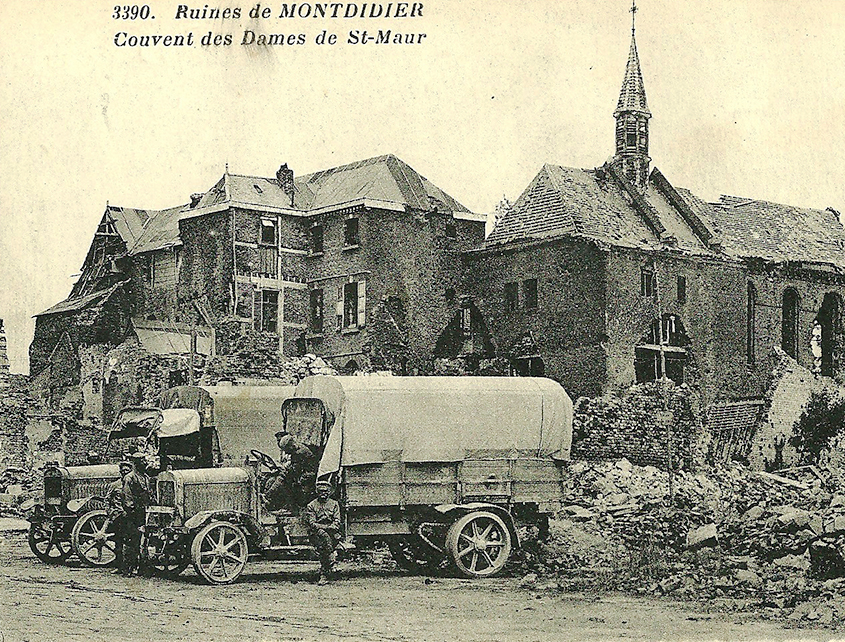 With
no mention of what happened to the lorries, the men entrained for Bulford
Camp on 7th April,
arriving the following day. On arrival the company was divided into two
parts. One part formed the Divisional Supply Column and the other the
Divisional Ammunition Park. The two companies were completed to war
strength with the addition of 150 drivers, from Grove Park ASC Recruitment
and Training Centre. The company also received its lorries, being Daimlers
with ten Commer 3-Ton GS lorries.
With
no mention of what happened to the lorries, the men entrained for Bulford
Camp on 7th April,
arriving the following day. On arrival the company was divided into two
parts. One part formed the Divisional Supply Column and the other the
Divisional Ammunition Park. The two companies were completed to war
strength with the addition of 150 drivers, from Grove Park ASC Recruitment
and Training Centre. The company also received its lorries, being Daimlers
with ten Commer 3-Ton GS lorries.
After drawing equipment and MT stores,
the two companies departed Bulford at 6.00am on the 11th,
arriving at Avonmouth at 2.00pm without mishap. The following day, the
lorries with two officers and fifty men embarked on the steamships
Trevaylor
and
Treverbyn. The
remaining three officers and 280 men entrained for Southampton and sailed
on ss.Mona’s Queen
on the 13th.
It was normal practice for ASC Companies
to arrive at Avonmouth as a complete unit and to only send a cadre of men
with the vehicles with the remainder travelling by rail to Southampton to
depart on troopships.
The Avonmouth ships arrived Rouen at
7.30pm on the 15th and were
disembarked by the early hours of the 16th.
By this time the Southampton ship had arrived Havre and the men arrived at
Rouen by train. The same day the companies departed Rouen for the front
and their French adventures could begin, just nine months after they had
mobilised in August 1914.