Even at today's value of £4,470, £50 per day does not seem excessive. It was the internationally agreed demurrage, compensation payable to ship owners, when ships were delayed at ports. Before looking at how quickly small amounts can become large amounts, it is necessary to consider some circumstances causing delays.
On 4th August 1914, three French ports were available for British Expeditionary Force use. These had been negotiated in 1911 and were Le Havre, Rouen and Boulogne. To state the obvious, they were French ports and Britain had by no means exclusive access. It was vital France could continue to trade with the world and maintain their fishing industry.
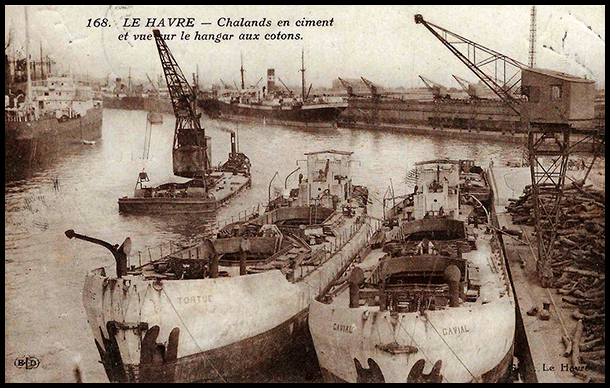
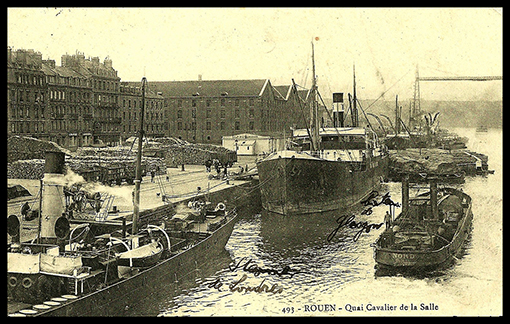
Boulogne was small and not accessible to shipping when the wind was from the wrong direction. Rouen was unable to accept large ships along the Seine, which also suffered with fog during the autumn. With the Seine only navigable at high tide, missing the tide caused a twelve-hour delay. Ships unable to leave port, prevented any ships arriving, so queues quickly formed. Only Le Havre had relatively easy access, but only seven available berths and dockside cranes not big enough for the heavier loads of the BEF. Discharging using the ship's own cranes took considerably longer than dockside cranes.
French dockers were reluctant to change their working practices, as were the British, fearing that worse working conditions would become the norm after the war. There was therefore no night or Sunday working. Not until late in 1914 were Army Service Corps labour companies allowed to work nights and later Sundays.
Sheds at the docks, essential for transhipping from ship to railway for the front, and accommodation for Base Depots were privately owned by French businesses. They were in short supply, needing requisitioning by the French authorities. The lack of suitable, available buildings led to warehousing further and further from the dockside being taken over. That incurred a time penalty transferring stores from dockside to store, through increasingly congested streets. Until the dockside was clear, the next ship could not commence discharging and the queue of ships awaiting berths gradually increased.
Inexperienced clerks and dockers at British ports were also unwittingly responsible for delays at French ports. Ports were losing experienced staff to the colours just as they were having to handle rapidly increasing tonnages of supplies for France. Inaccurate manifests created huge problems once the cargo reached France, particularly Le Havre and Rouen.
Every train leaving Base Ports for the front, was individually loaded with the supplies demanded by the unit they were destined for. Speedy loading of trains was essential, or the entire network could be disrupted. Loaders in the warehouses needed to know where different supplies were if delays were to be avoided. Hangar aux Coton in Le Havre was 400 metres long, so could take a long time to find anything not in its proper place. Inaccurate manifests inevitably delayed storing new supplies in the correct place.
Crates of stores, hastily labelled, sometimes just a barely legible scrawl, or at times rubbed away as crates scraped against each other when loading, unloading or during the voyage. Each needed opening to establish contents before being stored. Unloading onto the dockside allowed the ship to depart and the next to berth quickly. However, discharging the new ship could not commence until the dockside had been cleared.
Berths at Le Havre were often taken by shipping not destined for the port. Transatlantic ships were generally too big for Rouen and had to be part discharged at Le Havre to float them higher in the water and allow them to access the shallow berths at Rouen. Apart from occupying the berth, this required the dock's resources transhipping the loads onto rail for onward transmission to Rouen.
As the war progressed the number of ports available was increased, although, only with a restricted number of berths. When berths allocated for French use were empty, they were not available for British use, even when shipping was queuing. Discharging at allocated berths at Dieppe, taken over in February 1915, was delayed due to shortage of labour and reluctance of local contractors to work on Sundays.
At Dieppe, the ss.Warnow arrived on 27th April 1916 to be delayed for thirteen days. ss.Pontypridd arrived on 30th April 1916 to be delayed seventeen days. Thirty days demurrage accrued costing £1,500 [£101,073].
Welsh colliers supplying 135,000 tons of coal to the French railways per month accrued numerous days liable for demurrage. Between 4th February and 7th April 1916, eighty-six days were lost at Sete, Dunkerque, Le Havre, Nantes and Rouen. The cost was £4,300 [£289,743]. Delays were caused by the pre-war working practises of French dockers. They remained resolute despite warnings that they were causing delays on French railways, which inevitably affected the entire supply line. In addition to the ever-constant demurrage charges, the delays up to November 1915 had created a shortfall of 520,000 tons of coal delivered to the railways.
It may seem from the evidence so far that the French were entirely to blame for delays. That would be doing them a great disservice. On 25th May 1915, there were seventy-three ships lying at anchor in the Irish Sea awaiting berths at Liverpool, Barrow, Heywood and Fleetwood and access to the Manchester Ship Canal. £3,650 [£290,663] spent every day.
The number of waiting ships was unlikely to decline as more joined the queue as those at the front were berthed. The Ministry of Munitions regularly complained of delays at British ports due to labour shortages.
It was inevitable that ports on both sides of the Channel would suffer severe congestion. Designed in pre-industrialisation times they were simply swamped by the quantity of material produced by the ever-expanding munitions industry and BEF. Skilled labour lost to the colours meant increasing need for of unskilled labour, trade unions unwilling to give up hard fought for conditions all combined to mean delays were an inevitable fact of war.
|