 The British Expeditionary Force began
arriving in Boulogne on 9th
August 1914, when four officers established 3 Base Supply Depot at the
Bassin Loubet. Orders to evacuate ahead of the German advance were
received at 10.00pm on 25th
August, and the following day 3 Base Depot departed for Saint-Nazaire.
The British Expeditionary Force began
arriving in Boulogne on 9th
August 1914, when four officers established 3 Base Supply Depot at the
Bassin Loubet. Orders to evacuate ahead of the German advance were
received at 10.00pm on 25th
August, and the following day 3 Base Depot departed for Saint-Nazaire.
Within days, the Assistant Director of
Supplies Requisition Office received an invoice for 3,268Fr (£130.00
[£12,331 in 2023]). The invoice related to billeting officers from the 9th
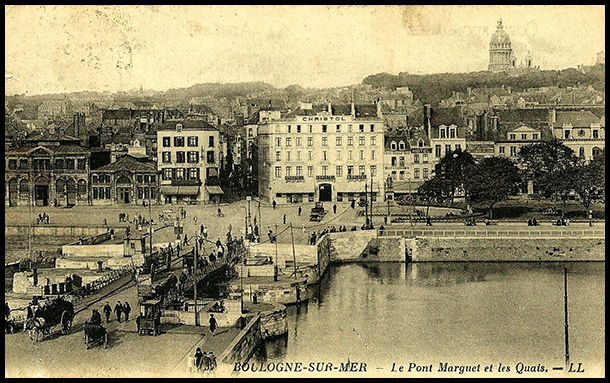
to 25th at the Hotel Christol
on the corner of Place Frederic Sauvage, Boulogne. The first transport to
return to Boulogne was 318 Coy ASC (6 Auxiliary Petrol Coy) on 1st
October and 3 Base Depot was re-established on 14th
October. Hotel Christol appears to have become a British hospital.
The British Red Cross Society requested
on 19th September that the
Allied Forces Base Hospital be sent to France. Permission was refused by
the Army Council who stated that it would need a formal request from the
French authorities before the request could be considered. Furthermore,
the AFBH had been allocated a site at Cosham, Hampshire by the Officer
Commanding Coast Defences at Portsmouth where it would be connected to the
Alexandra Military Hospital.
While the Army Council were refusing their
permission, the Executive Committee of the AFBH were engaged in an
emergency meeting at their offices at 16 Grosvenor Street, London. This
was to consider an urgent request from the French Red Cross Society and
the French Military Authorities. A suitable building at the College St
Marie, Pont-Saint-Maxence had been allocated and the hospital would remain
British and permitted to fly the British flag.
Subsequently, a telegram was sent to
Admiralty Transports, Southampton demanding shipping for twelve medical
officers, seventy-six personnel, four motor cars and 700 tons of stores.
This was the AFBH, stored in the Royal Mail Steam Packet Co warehouse, for
shipment to Havre, en-route for Boulogne where it would be erected in the
Hotel Christol. Thirty nurses were also travelling on the night packet
later that day.
The hotel’s proprietor, M. Louis Paul
Sagnier, had dictated terms for the lease, which the Inspector-General
Communications, Maj-Gen RC Maxwell, opposed, considering they were too
one-sided. A second building at 45 Rue de l’Amiral Bruix, Boulogne was
included in the tenancy agreement. It comprised the ground floor, two
storeys and a cellar, although no evidence of it being used has been
found. The buildings were to be used as a hospital for wounded British
officers.
The length of the lease was for one month
only, renewable monthly with the rent of 300FFr (£12.00 [£1,144]) paid in
advance. The arrangement being available only for the duration of the war.
The War Office were responsible for all
maintenance, damages, local land and the door and window taxes. No
structural alterations were permitted and the buildings had to be handed
back in the same condition as when taken over. There was no recourse for
the cost of repairs to be partially reimbursed, even when the repairs
improved the condition of the building.
The buildings were to be hired unfurnished.
All the furniture, wall hangings, linen and bedding to be removed under M.
Sagnier’s supervision to a location agreed by both parties and stored in
good condition. It was to be returned at the termination of the hire
agreement, with any damage repaired at War Office expense. The agreement
included the personal furniture and possessions of M. Sagnier. Two
underground cellars were retained at the hotel for the storage of crockery
and the hotel’s wine stocks were to be kept locked in a cellar.
At the end of the month seven nurses and
twelve orderlies were granted passes to travel to the AFBH. They were
urgently needed as the 200-bed hospital was full of wounded soldiers. The
AFBH’s 200 beds were a tiny proportion of the 5,195 available in the
eighteen hospitals established in Boulogne.
 A small, but significant enough cost to
vex the Director of Supplies, Major-General FT Clayton, was the 2,000 eggs
consumed by the Boulogne hospitals each day. On 18th
November he reported that it was necessary to purchase eggs locally at
cost of 520Fr (£20.70 [£1,963]) every day. This was due to the hospitals
refusing to use eggs sent from home due to their deterioration during
transit. The cost would inevitably increase at the end of the month when
the contract for eggs held by AFBH with Harrods was due to expire and not
be renewed. Clayton anticipated that he would become responsible for all
the AFBH’s needs.
A small, but significant enough cost to
vex the Director of Supplies, Major-General FT Clayton, was the 2,000 eggs
consumed by the Boulogne hospitals each day. On 18th
November he reported that it was necessary to purchase eggs locally at
cost of 520Fr (£20.70 [£1,963]) every day. This was due to the hospitals
refusing to use eggs sent from home due to their deterioration during
transit. The cost would inevitably increase at the end of the month when
the contract for eggs held by AFBH with Harrods was due to expire and not
be renewed. Clayton anticipated that he would become responsible for all
the AFBH’s needs.
Three days later, a letter from the War
Office in London informed that supplying eggs from London would save money
as French eggs were very expensive. Clayton stipulated that the Boulogne
boat should be used, and that he could arrange transport if he received
notice of each shipment. Why they would not deteriorate as before is not
explained. It is also doubtful that they would be cheaper when transport
costs were accounted for. He did refuse to accept the milk the War Office
was intending to send as it would be too old by the time it reached
Boulogne.
Little more has been found about the
AFBH, and the Hotel Christol was given up on 21st
January 1915. The hotel then became the headquarters of the British Red
Cross Society in France with BRCS becoming responsible for all the costs.
On 18 March, IGC received a bill for 10,889FFr (£411.00 [£33,373]) from M.
Sagnier for charges outstanding to 21st
January. IGC requested that the WO pay the account as the AFBH ‘was no
longer in France’ and therefore he had no facility to settle the arrears.
Sixty-three medal cards have been found
with the majority showing personnel as being BRCS. One, Captain Pearce,
Royal Naval Air Service, was refused a 1914-15 Star as AFBH was not
eligible, although all of the others were awarded the 1914-15 Star. The
AFBH is also recorded on the cards as being at Etaples, not Boulogne.