Edward Darby worked
for a wealthy American family in London. When they returned home in August
1914, he planned to go with them and submitted the paperwork to do so. A
skilled mechanic and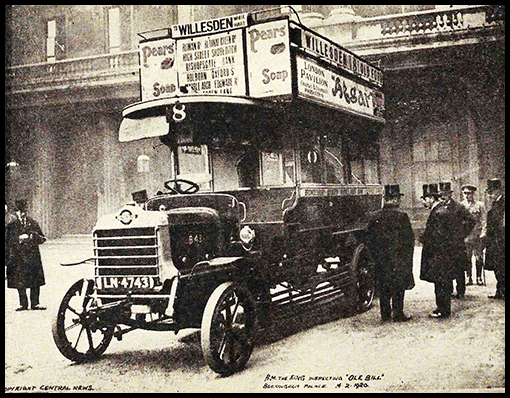 driver, he was a member of the Society of Automobile
Mechanics. While awaiting his papers for America, he received a letter
from the SMA that changed his life. It informed him that the army was in
desperate need of skilled mechanics and invited him to volunteer.
Believing the rumours that the war would be over by Christmas, he resolved
to do his patriotic duty.
driver, he was a member of the Society of Automobile
Mechanics. While awaiting his papers for America, he received a letter
from the SMA that changed his life. It informed him that the army was in
desperate need of skilled mechanics and invited him to volunteer.
Believing the rumours that the war would be over by Christmas, he resolved
to do his patriotic duty.
It was thus that he
found himself at the Whitehall Recruiting Centre at 10.00am on the 19th
October 1914. Sworn in to serve King and country for one year, or the
duration of the war, he found himself at Grove Park Army Service Corps
centre. Medical passed, uniform, paybook and regimental number issued, he
was given lunch and just a handful of hours after walking into the
Recruitment Centre was on a parade ground and in the army!
He was then sent to
Dalston Bus Garage. Where, with his new mate, he waited for an omnibus to
return from its day’s work when they took it over and returned to Grove
Park. In less than one day, Darby had gone from civilian to soldier with
‘his’ bus, B1805, which he named ‘Nelson’ due to the number.
The following morning,
the bus was filled with petrol and tins of grey paint and Grove Park was
departed. It was not until later in the year that the familiar ‘army
khaki’ began to replace the pre-war grey colour used by the Royal Navy.
Stopping overnight at Ascot Racecourse, Berkshire, they slept in the
grandstand. Here, Darby was able to purchase a postcard and inform his
girlfriend as to what he had done!
Rested, the convoy of
new recruits left at 10.00am the next morning, arriving at Marlborough.
Parked in the High Street, the Sergeant-Major informed them that the
following day they would embark for France. Each man was then issued with
a First Field Dressing and a rifle. After three days, he was an armed
soldier! Darby recounts his surprise that France was their destination,
noting that they were a motley group of bus drivers, cab drivers, car
drivers and a tram driver with minimal ability.
Day four, and the real
soldiering commenced with a course in Musketry and Arms Drill while the
dockers loaded their buses onto a tramp steamer at Avonmouth. Once aboard,
they were greeted by the stench that was testament to the disembarking
Belgian refugees’ far from pleasant voyage. The unpleasantness suffered
was confirmed by the two-day voyage to Le Havre, when it was discovered
that few of Darby’s new comrades had developed their sea-legs. Hope of
finding land at Le Havre was dashed when orders were received that Rouen
was the destination, a further day aboard the, by now, very foul ship.
Just seven days after
stepping through the Recruitment Centre door, Darby found himself stood on
French soil, albeit pleased to be back on terra firma. Relief was short
lived as he discovered how kind-hearted the senior officers in France
could be. They had ordered a route march in compensation for being couped
up on ship for three days. Returning from the march, he was surprised to
find that his bus, along with the others, was being attacked by French
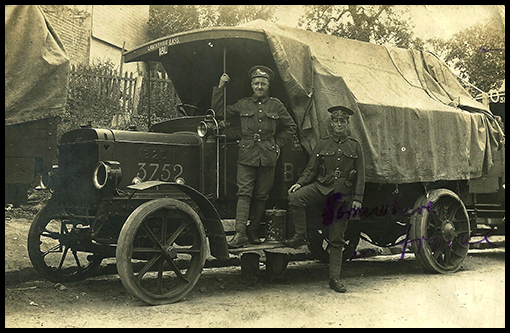
carpenters removing the upper decks thereby turning the buses into
lorries.
This is the first
indication that Darby had been enlisted into 93 Coy ASC (4 Auxiliary
Omnibus Coy). Four bus companies had been formed in October 1914. 90 and
91 Coys were retained as bus companies on arrival in France, while 92 Coy
was converted to lorries and re-designated 4 GHQ Ammunition Park. 93 Coy
was re-designated 1 Mobile Repair Shop. It had no buses or lorries on its
establishment, other than breakdown lorries, and there is no record of
what happened to the personnel and vehicles. Darby recounts that he was
transferred, with bus, to 46 Coy ASC (2 Cavalry Division Supply Column).
Buses converted, the
company left Rouen the same day, arriving at Abbeville for the night. At
Abbeville, he found a bakery and already tired of Iron Rations for his
first week of Army life, he purchased some bread and buns. He was informed
that the following morning the company would be leaving for Saint-Omer and
he was to ride ahead on a motorcycle to check that the road was suitable
for lorries.
 A French officer
joined the company the following morning as the interpreter. He was
sensibly chosen to replace Darby and recce the route. Darby returned to
the remains of his bus for the journey to Saint-Omer. Expecting a rest at
Saint-Omer, he was disappointed to find his rest cut short as orders were
received to move the same day to Hazebrouck. Here the company was formed
into 2 Cavalry Division Supply Column.
A French officer
joined the company the following morning as the interpreter. He was
sensibly chosen to replace Darby and recce the route. Darby returned to
the remains of his bus for the journey to Saint-Omer. Expecting a rest at
Saint-Omer, he was disappointed to find his rest cut short as orders were
received to move the same day to Hazebrouck. Here the company was formed
into 2 Cavalry Division Supply Column.
It consisted of a
random collection of lorries and parcel vans etc., requisitioned from
companies such as Pickfords and the CO-OP, whose large biscuit van proudly
advertised their trade in Manchester. An opportunity was taken to purloin
tarpaulin covers from railway trucks in attempt to make their ‘lorries’
weatherproof.
At their destination,
with the promise that the constant moving was at an end, Darby was able to
reflect that it was just nine days after he had walked into the Recruiting
Office in London. In that short time, he had become a professional
soldier, travelled to a foreign country and was parked next to heavy
Howitzer Guns. He reflected on the sound of the guns and the flashes that
lit up the night sky and firmly reinforced the fact that he was now a
soldier on the frontline.
2 Cavalry DSC ceased to exist at Abbeville on 1st May 1919.