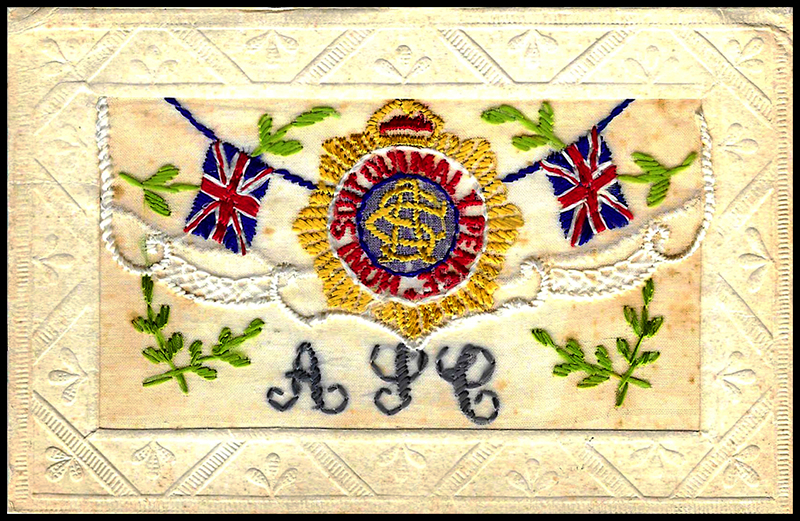
 The man in the
trench cared not how his food arrived, only that it did. The gunner cared
only that his shells arrived, though probably less about his shells than
his food. The Generals and the War Office in London cared not for the day
to day working of the Supply Line, any more than the Board of Directors of
a modern supermarket. Only when it failed to deliver did the largest Corps
in the British Army become visible during the Great War of 1914-18. So
long as it worked it remained invisible to all.
The man in the
trench cared not how his food arrived, only that it did. The gunner cared
only that his shells arrived, though probably less about his shells than
his food. The Generals and the War Office in London cared not for the day
to day working of the Supply Line, any more than the Board of Directors of
a modern supermarket. Only when it failed to deliver did the largest Corps
in the British Army become visible during the Great War of 1914-18. So
long as it worked it remained invisible to all.
“Pending the improvement of railway and road communications, no further advance will take place after completion of moves on the 20th instant….. The army has now been functioning in the Supply System and, perhaps has realized some of the difficulties which we have had to combat with".1
Comments
recorded
by Lt
Col
EH
Blamey,
IX
Corps,
Senior
Mechanical
Transport
Officer [SMTO].2 Comments
that
begged
further
investigation,
particularly
as
the
Line
of Communication
[LoC]3 had
been
undergoing
a two-year
transformation
to
improve
efficiency,
not
stop
the
army in
its
tracks.
What
transpired
was stories
of superhuman endurance, inter-service
rivalries
and
conflict
between
military
and
civilian
perspectives.
Blamey
arrived
in France
with
the
Army
Service Corps
[ASC]4 on
21
September
1914.
In
February 1917
he was promoted
to IX
Corps SMTO.
His comments need taking in
the
context
of war diaries being
a narrow perspective of a commanding officer
[CO]
too
busy
to be
interested
in adjacent
theatres.
Just
as the
man in
the
trench
had
no
interest
in
how
his
meal
arrived,
the
ASC had
no practical interest
in
how
anything
arrived
at railhead.
That
did not
mean they
were
afraid of criticising others
or were
immune from
inter-service
rivalry.
The
LoC
comprised
standard
gauge
railway from
the
port
of entry
to
the Supply
Railhead,5 where
supplies
were
transferred
to Divisional
Supply
Columns
[DSC].6 These
conveyed supplies
by road
to Refilling
Points7 using
Mechanical
Transport
[MT]8 from
where the Divisional
Train9 delivered
to frontline
troops
using
horse
transport
[HT].
The
French owned and operated railways were responsible
for
the
line
up to
railhead
and
the ASC from
railhead
to frontline.
Both
were
independent of each other
while being
inextricably
dependent on each other.
The
ASC
was responsible
for feeding
164,000 men and 27,500
animals
in 1914.
By the
Armistice,
the
feeding
strength
was
5,363,352
men and 845,770
animals
in all
theatres,
of which
2,360,400
men and 404,000 animals
were
in France.10
On the
eve of
war,
ASC strength
was 6,431
men, comprising 498
regular
officers and
5,933
other
ranks. At
the
Armistice, the strength
was 325,888, comprising
10,547 officers and
315,334
other
ranks. A further
82,638
men had
been
transferred
to
the infantry,
artillery and
machine gun corps with
686
officers and
15,547
men killed
in action.11
In
August
1914
ASC MT
comprised
only
eighty
lorries,
twenty
cars and
fifteen
motorcycles.
Lorries
registered under
the Subsidy Scheme12 increased
the
total
to 900.
900 was
the
Army Council’s
requirement
to mobilise
the BEF
in
1911, which
remained
unchanged until
1914.13 The army wanted
900 and the
Treasury
was not going
to pay
for 901.
Subsidised
and requisitioned vehicles
meant
that
1,061 lorries,
193 cars
and eleven
motorcycles
were
mobilised.
By 11
November
1918,
MT
in all
theatres
had
grown
to 121,702 motorised
vehicles of all
types.
There
were
twenty ASC
MT Coys
in 1914,
increased
to 605
by 1918
and, whilst
this
article
will concentrate
on MT,
it cannot
be forgotten
that
HT companies
also
increased
from forty
to 552.14
It
is
necessary to consider
that
the
expansion was achieved
despite
a constant
dearth of
assets,
whether
vehicle,
petrol,
spare
parts
or skilled
tradesmen.
Not
all
the
original
MT
companies
had any vehicles.
They were classified
as MT
because
their
personnel
had received at
least
basic
MT
training.
62
Coy
ASC (2 Division
Ammunition
Park)
[AP]15 personnel,
without
any transport, arrived
by rail
at
Avonmouth
on Mobilisation Day.
It received
seventy-one impressed
lorries of which
26%
were
unfit
for service
overseas and
left
behind
when
the
company sailed
for Rouen.
On arrival
at
Amiens
Advanced
Base
on 8 August,
39%
were
unserviceable.16
War Office
[WO]
correspondence
dated 3
September
1914 reveals
that
available
lorries
suitable for
impressment had
reduced to
twenty
per week and
output
of new
lorries
was only
100.
Also
“It appears
to
be certain
that
great
difficulty
will
be experienced in obtaining
suitable
officers
for what is
really
technical
work requiring
considerable
experience
and knowledge of movements
of troops.”17 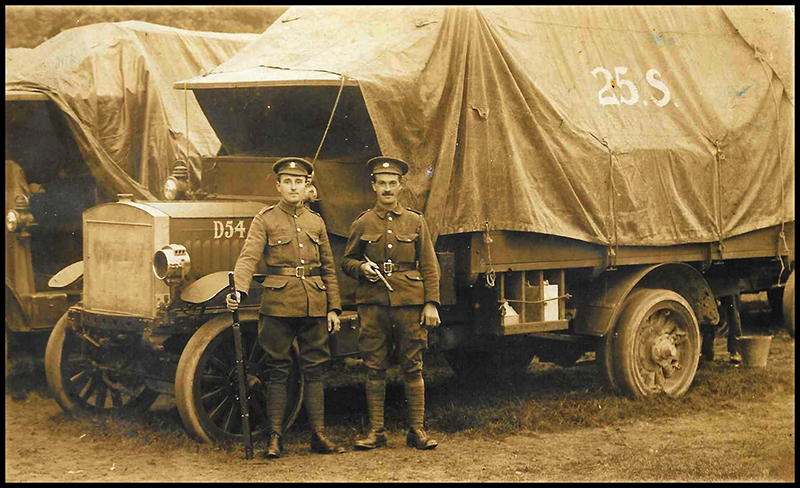
Brig
WGB
Boyce, Director
of
Transport, [DT]18 Saint-Omer,
France recorded
on 6 December
1914
that
twenty-three
MT, forty-four
HT and
twenty-one Supply
Officers were
to
return
home to England for training new units. They
were
the
only officers
with experience away from
the
training
ground
or classroom.19
No
part
of the
British
Expeditionary
Force [BEF]
was immune
from
the lack of skilled men.
Equally,
industry
lost
a skilled
workforce as men enlisted
to
be unskilled soldiers.
It
was
the
inevitable
result of the
mass recruitment
of volunteers
necessary to fuel
the
expansion
of the
BEF
in France.
Unskilled labour
could
march
down
a road to
the front
but
driving
motor
lorries
or looking
after
a
team
of horses was skilled
work. The
ASC
inevitably
suffered more from
the
lack of
skilled men
than
the
infantry.
By September
1915,
MT
drivers
were returning
home as mentors
to newly
qualified drivers.20 Home
MT
Units were
used as finishing
schools
for new
drivers
before
they
went overseas
and
the
speed of training,
with subsequent
lower
standard, was
having a
detrimental
impact
on efficiency
in France.
ASC
growth
followed
the expansion
of the
armies. New
companies were formed
piecemeal and allocated
as DSCs, Ammunition
Sub
Parks
[ASP]21 and
Motor Ambulance
Convoys [MAC]22 when
new
vehicles
and personnel
became available.
It
was 1917
before
a more
holistic
view
was taken and reorganising
the
LoC commenced.
The
first
record
of
the
reorganisation
found
to date
is
15 September 1916.
Col
ERO
Ludlow,
VI Corps
Adjutant, mentions
a letter from
GHQ requesting
comments
on a
proposal
that
MT
be placed
under
corps,
not
divisional,
control.23
At
the
same
time,
Eric
Geddes24 (later
Sir Eric
Geddes)
was conducting
his review
of transport
in
France. He had been sent
to France
in
August 1916 with
the remit
detailed
in correspondence
between
David Lloyd
George and
General Haig.
Lloyd George
wrote
on 1 August 1916.
“The problem
of developing our
transport
facilities in order both
to accelerate
and
to
augment
the
despatch
of stores
is one
that
is giving
me some anxiety. The output
at
home
of munitions
has now so
greatly
increased, that
we can meet with
comparative
ease the higher
demands
which
you quite
properly
make
on us,
but
I doubt
whether,
without
careful
preparation,
the
powers of absorption
of
the
ports
and lines of communication
can expand
to a commensurate degree. What
I have specially
in mind
is the
desirability of ensuring
such expansion as will
next
year, and
the year
after
if
necessary, enable us
to cope
with the
ever-increasing
volume
of munitions
and stores
which will
be needed for the service
of your force. I realise
some of the difficulties
but
I think
it
would
perhaps
help us
if an
examination
of
the
transport arrangements
in connection with
the
British
Expeditionary
Force in
this
country
and
overseas were undertaken
by
an expert
investigator.
I have
accordingly
arranged
with
the
Quartermaster-General
that
Eric
Geddes,
who has
had very special
experience
of
this
subject, should
look
into
the
question of road, railway,
canal, dock and other
means of communication.”25
Haig
responded
“As regards
the enquiry
into
our
transport
arrangements by Eric
Geddes,
you will, I am
sure realise
that
everyone
behind
the army,
no less
than
those
at
the
front
is
working
at
such high
pressure at
present
that
they will
not
be
able to devote
as much
time
to him
as
we
should
like.”26
On 16
August,
Lloyd
George
again
wrote
to Haig
regarding
Geddes’
investigation.
“There are
three
points
in
particular
which I would
like him
to
talk over
with
you. One
is
the question
of Transport
facilities
for the
very considerably
increased quantity
of ammunition and other
stores
which
we
are expecting
to
send you.
Another
is
the
difficulty
which
has arisen
over the great
shortage
of petrol.
I am really afraid
that
unless
we are
able
to effect some
economy in
petrol,
we shall
be faced
with
the
stoppage
or curtailment
of
the
motor
bus services, which
the
working
classes are
so largely
dependent
upon.
The
third
is
the
question
of repair and
working of ports,
railways,
canals
and roads
in
the case of an advance,
having regard
to
the
difficulties as
to men and
materials
in
this
country.”27
Haig
was fully engrossed
with
the
Battle
of
the
Somme. The
army was struggling
to maintain
ammunition
and supplies. Looking forward
to the
next week
was
impossible,
let
alone
into
the
following
year, as Lloyd George was able
to
do.
Lloyd
George
realised
that
a
holistic
transport
system would
be required
if
it
was to
cope
with
the
planned
escalation
of munitions
production.
His
concerns regarding
petrol
consumption
were reinforced
when
the
War Cabinet
was
informed
that
the
country’s
reserve
stocks of
petrol
on 13
January 1917
were 26,000,000 gallons,
reduced from
37,500,000 on 9
December. Unless
consumption was reduced
the
reserves
would
be
totally
depleted
by Easter.28
Lloyd
George
was also
aware
of the
looming
perilous
financial
position
that
Haig
would
have
no, or at best very little, knowledge
of. On
24 October 1916,
Reginald
McKenna,
Chancellor
of
the
Exchequer,
reported
on the
financial
position with
America.29 Expenditure
between
May and September
1916 had
been
estimated
as $795,000,000
(£167,016,807
[£10,113,431,129 in 2025])30 but
was actually
$985,000,000
[£12,530,477,536].
Committed
expenditure
in
America
to
March 1917
was
$1,250,000,000
[£15,901,621,245]. This
did not
include
the
Ministry
of Munitions orders
yet
to be finalised.
JP Morgan Bank was
tasked with
raising
$1,500,000,000 [£19,081,945,470]
by
the
end of March 1917.
JP
Morgan’s
New York
office responded
on 10 October.
“The money required
is more
than,
or as much as exists.”31
 It
is evident
that
the escalating
cost of the war had
to be
brought
under control, yet
the
proposed
further
industrialisation,
promised
the opposite. With
the
front
line
largely
static, it
was
possible
to run
the railways
along civilian
principles
with
fixed
railheads
and
timetable.
Geddes’
experience
made
him
perfect
for the
role
and on 10 October
1916, he was appointed as Director-General
of Transportation
[DGT] with
the
British
Armies
in France and
Belgium,
with
the
honorary rank of Major-General. He needed
a rank of sufficient seniority
to communicate
on
level
terms with
GHQ senior officers.
The
post
had
responsibility for
the
supply
line
from
the
port
of entry
to railheads and
light
railway
[LR]
termini,
including
inland
waterways.
The army remained responsible
for movements
in
front
of the railway.
It
is evident
that
the escalating
cost of the war had
to be
brought
under control, yet
the
proposed
further
industrialisation,
promised
the opposite. With
the
front
line
largely
static, it
was
possible
to run
the railways
along civilian
principles
with
fixed
railheads
and
timetable.
Geddes’
experience
made
him
perfect
for the
role
and on 10 October
1916, he was appointed as Director-General
of Transportation
[DGT] with
the
British
Armies
in France and
Belgium,
with
the
honorary rank of Major-General. He needed
a rank of sufficient seniority
to communicate
on
level
terms with
GHQ senior officers.
The
post
had
responsibility for
the
supply
line
from
the
port
of entry
to railheads and
light
railway
[LR]
termini,
including
inland
waterways.
The army remained responsible
for movements
in
front
of the railway.
Central
to
the
Geddes
reorganisation
was extending
the rail
network,
particularly
the
use of LR.
LR
was quicker
to
lay
than
building new roads
and
saved road material
that
was constantly
in
short supply.
In March 1917, the
need
for sufficient
roadstone was
the subject
of a
conference attended
by
the Fifth Army
Deputy
Assistant
Director
of
Transport
[DADT]32. Here
it
was
considered
which
roads were to be maintained,
allowed
to fall into
disuse
or
be
taken
up
to provide
road material for
the
repair
of more
important
routes.33
LR
was crucial
in shortening
the
distance
lorries
travelled
between
railhead and refilling point.
This
was important
as
all
MT was overworked
with
increasing
numbers
unserviceable
for
want of spare parts.
Raw materials
for
transport
had
never been a WO
priority and
Halley
Motors Ltd’s
wartime
contracts
provide
insight
into
WO priorities.
The
Glasgow
Company
produced
a respectable
ten
lorry
and bus
chassis
per week
prior
to
August
1914, when
the entire
production
was taken over by
the
WO. Difficulty
obtaining
raw materials
and
losing skilled
men to
the
war effort,
reduced
production
to
ten chassis
per
month.
In May
1916, all
lorry production
was
stopped,
despite
MT
being
desperately
needed,
and
a contract
for 110,000
shells was awarded at the rate
of 4,000
per week.34
To
facilitate this,
the
WO
built
a factory
extension
at
the cost
of £85,000 [£6,453,592]35.
The WO found
the
resources
to increase
munitions
production
while
prepared
to sacrifice
the means
to move
that
production.
Authority
to reorganise
the
MT Units
in
France was given
by WO letter (121/France/147
S.D.2),
on 5
January 1917.
It
was anticipated that
each corps would
save 200
artificers,
680 rank and file, 160
lorries,
twenty
workshops
and
twenty
store
lorries.36
Lt
Col
GH Harvey, XV Corps,
SMTO,
provides
insight
into
the reorganisation,
which
unusually pre-dates
his appointment as
SMTO
on
1
February 1917
when the
new
office
was opened.37 In
August
1916 he
was CO of
XV Corps
ASP. At
the end of
August,
he was
appointed
‘Officer
Commanding
Mechanical
Transport’ within
the Corps.
This role
became necessary as so
many extraneous
duties
had become urgent,
that
a central
power
was needed
to control
the
use of MT
within
the
Corps.
The
diary,
which
takes
the form
of a history,
not daily
record,
describes
the
reorganisation
and
role of
the SMTO.
“On 1
February
1917
the
Mechanical
Transport
of the XV
Corps was reorganised
and
put
on a Corps basis as follows:
Headquarters
“P” Corps
Supply Column
“P” Corps
Ammunition
Park “P” Siege Artillery
Park.
All
the
three
units
were
distinguished
by
the
prefix “P”
and were
not necessarily
part
of
the
XV Corps.
The
duties
of the various
officers were
never clearly
defined,
but
were
taken
to
be
as follows;
The
SMTO
had
three
separate
functions;
1 -
With
the
Deputy
Adjutant-General’s
Office at Base he dealt
with
reinforcements,
hence he received
and passed
the
weekly
AFB 213A,
noted
and
monitored
the surpluses
and deficiencies
and adjusted
them
as far as possible.
2
– With
the
Deputy
Director
of Supplies
& Transport, Fourth
Army he acted as
Assistant
Director
of Mechanical
Transport,
answering
all
questions
on MT.
3 –
With
HQ XV Corps he acted
as a Brigadier-General,
dealing
with
each formation
as a battalion.
He
noted such lorries
as were not
wanted
for
their
normal supply
or ammunition
work and
detailed
them
for extraneous
duties.
The
officers
commanding
the
“P”
Supply Column, “P”
Ammunition
Park
and
“P”
Siege
Ammunition
Park
also
had three
functions;
dealing
with
the
SMTO
as regards
all
matters of MT,
dealing
with Corps
HQ
to relieve
Corps “Q”
of much of
the supply
work and
with
the
Corps
“A” on matters of discipline as a Battalion
Commander
of
Troops.”38
Administration
of ASC MT companies
was removed from
Divisional
control
and
centralised
under Corps, creating
the post of
SMTO.
Promoted
from
commanding
an ASP
the
SMTO
had an unenviable workload.
VIII
Corps SMTO
reported
to
the
Corps
Deputy Adjutant
& Quartermaster-General
[A&QMG]
in May 1917 that
he
had
forty
MT
Units under his
command and averaged 200
letters
per
day.39
DSCs
and
APs thus
came under
direct
orders
of
the
Corps. Bringing
all
the
units under
one
administration allowed
War Establishments
[WE]40 to
be reduced.
Vehicles
that
became surplus
to
WE were
used to create
‘letter’
units,
intended
as
Corps
Reserve
Units
[CRU].41 Creating
CRUs ensured
that
MT surplus
to
establishment
was retained
by the
corps.
Reorganising
was taking
place
within
the
wider
rationalising
of the armies
on the
Western
Front.
The
savings
refer
to assets,
with
no
interest
in the
financial.
There
is
no reason
why troops
in
France would
be
aware of the
workings
of the Treasury
in London.
Fewer
lorries
released drivers
for the infantry,
required
less
parking
space,
spare
parts,
petrol,
etc. ASC records always
cast
doubt
as
to
whether
there
was room
for any reduction, but
the
effect was to focus minds
to maximise
the
use of available
resources.
It
would
be remarkable
if any organisation applauded
any reduction in assets
and
the
ASC
were
no exception.
Reality
was that
supply
of new MT from
home had almost
dried
up.
The DT had advised
QMG
on 2 February 1917
that
the
reserve
was being used
quicker
than
it could
be replenished.
No spare
parts
had arrived
in France for
three
weeks,
increasing
the number
of unserviceable MT.42 The WO therefore
determined
that the WE of every
MT company,
except
the
omnibus companies
and MACs,
had
to
be
reduced.
On 1
February
1917, 44%
of XV Corps
lorries
were unserviceable.43 On
10
February, Fourth
Army’s
unserviceable
vehicle
situation
was: ANZAC
Corps
- 217
unserviceable
from 560
(39%);
III Corps - 132
from 665
(20%);
XIV Corps
-
255
from 662
(39%)
and XV Corps - 231
from 608
(38%).44 The WE
for MT companies
allowed
for 25%
spare
lorries
to replace
any in workshops. Only
III Corps were
using
less
than
their
25% spare
and were able
to operate
at full
strength.
To quote the diary
“This
was
due
to several
reasons, but
chiefly
because MT
was doing
work
for
which
it
was
never made,
was given
no rest
for
timely
repairs,
had
no opportunity
for making good
the ravages
of 1916 and
was
generally
considered a slave
to be used
at will, ill-treated
and
parked
anywhere.”45
By
the
end of February,
the DT
felt obliged
to inform
QMG
that
the
BEF’s overworking
of lorries meant
there
were 990 in unit workshops and,
despite
knowing
lorries
from England
were
in short
supply,
680
were needed
immediately
to replace
derelicts.46 990
is equivalent
to
an entire corps
being
without
MT and
reliant
on
HT.
Lt
Col
WT
Hollins,
XVII Corps,
SMTO
illustrates
the problems
faced by their
MT
in
March 1917
when operating
between
Saint-Pol-sur-Ternois
and
Arras.
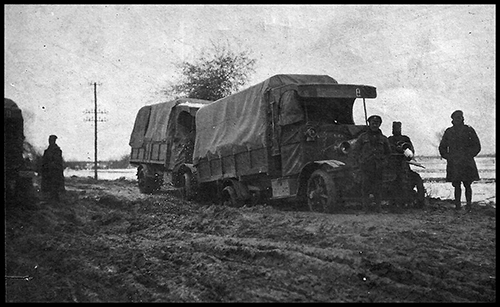
The state of
the
roads
caused a 4-mph
speed limit
to be
imposed
which was
half
the normal
limit.
It
forced
Hollins
to request
that
lorries
be used
with
only one driver so the
second could rest.
Lorries
were working
for thirty-six hours without
breaks and drivers
needed rest.47 It
should
be
noted
that
while
Hollins
was keen
to emphasise
the overworking
of MT,
he
made
no mention of
the
harshest
weather
conditions for
decades
as the
cause of
the
poor
road conditions.
 At
the
beginning
of March, a conference
of Corps and Divisional
HQs was convened
to
determine
a method
for making
the
new transport
work. It was
decided
that
all
demands
for
lorries
must
be made
by 8.00pm
the
previous
day. Previously,
it
had been
impossible
to plan
MT
as demands were
made
often as
late
as 2.30am on
the
day needed.
The
new deadline
did not solve
the
issue
of lorries
standing at
railheads for hours
when needed
elsewhere.
Nor
did
it
address the
lack of available
of MT.48
At
the
beginning
of March, a conference
of Corps and Divisional
HQs was convened
to
determine
a method
for making
the
new transport
work. It was
decided
that
all
demands
for
lorries
must
be made
by 8.00pm
the
previous
day. Previously,
it
had been
impossible
to plan
MT
as demands were
made
often as
late
as 2.30am on
the
day needed.
The
new deadline
did not solve
the
issue
of lorries
standing at
railheads for hours
when needed
elsewhere.
Nor
did
it
address the
lack of available
of MT.48
The
reduction
in
WE
and
the additional
work demanded
by the army was creating
a
perfect
storm. Lt
Col
RW
Courtney,
VII Corps,
SMTO, in
the same area as XVII Corps
reported
the
overworking of lorries
to headquarters
in a
memorandum on 17 March.
“I
beg
to bring
to
notice
the
fact
that
the MT
is being,
at
present,
seriously
overworked,
and, should
it continue,
the
breakdown
of the
MT
is only
a matter
of
time.
The
chief
cause
of this
overwork
is
the
fact
that
after
lorries
have
carried
out
their
normal
work and
returned
to
Park,
they
are ordered
out again at once for
stone carrying,
coal, etc,
which
results in
the
lorries being
out
all or nearly
all
night,
and again
having
to
do
their
normal
work
early
next
morning.
During
the
past
week,
252 lorries
have been
continuously
on
the road
for over 40 hours
at a
stretch.
The
great
majority
of
the remainder
average between
12 and 18 hours. This
discloses
a state of things
which
neither
personnel
nor vehicles
can stand,
particularly
over
these
bad roads, and I
am anxious
to make
it clear
that
necessary
work
which
may
shortly
be
expected will
be seriously
interfered
with
unless
more care
is exercised
at
this
juncture and a
considerable
reduction
made
in
the work
of the MT.”49
Throughout
March,
trains
were
either
late,
often
by
as much as twenty-four
hours, or did
not arrive at all.
On 17 March,
XVII Corps
lorries
waited
eighteen hours for
a supply
train at
Aubigny-en-Artois.
On arrival
it
was 2,000
gallons
of petrol,
in
2-gallon
tins, and 2,000
men’s rations short.50 The lorries
had
to
travel
fifteen
miles,
taking
some
three
hours, to collect
the
shortfall
at Frevent.
At
least
six
hours
plus
the
loading
time further added
to
the shift,
already
extended
by eighteen
hours
at
Aubigny.
Equally important,
a column
of
lorries
had stood
idle when
desperately
needed
elsewhere.
Such
was
the
deterioration
in
the
general
transport
situation
in
Third
Army, that a
conference
was convened
on 23 March at
Frevent
Station.
Gen
Dawkins, Deputy
Quartermaster-General,
HQ
presided
and others
present were Gen
Sillem, Deputy
Adjutant
& Quartermaster-General
[DA&QMG],
Third
Army
Deputy
Director
Supplies &
Transport
[DDS&T], VI, VII, XVII
and
XVIII Corps
SMTOs,
Adjutant
XIX Corps
MT,
Third
Army Deputy
Assistant
Director
Railway
Traffic
[DADRT],
the Army
Roads
Officer and
various
Railway
Transport
Officers
and Corps
Roads Officers.
The
conference
concluded
that
“The chief
difficulties
seem
to centre
on Railway
Traffic
which
resulted
in Trains
being
most
uncertain and
transport
accordingly wasted,
in
waiting for
them.”51
After the conference,
the
DT
toured
railheads
in
the
Third
Army area.
He concluded
that
MT
at every
one was
being worked
to breaking point
and was content
to
blame
poor
planning
and reliability
of
the
railways.
A census revealed that
of the
299
spare
lorries
permitted under
Third
Army’s WE,
658
were
unserviceable.
Third
Army
had overworked
its
MT
to
the
point
where
it
was unable
to move,
either in advance
or retreat.52 It
has already been
seen
that
Fourth
Army were
in
the same situation.
The
census highlighted
the
need
for a centralised
system
to
operate
MT
by equalising
workloads between
units.
Lt Col EF Blakeney,
VI Corps, SMTO
felt
compelled
to write to Corps
HQ
to explain
in
more
detail his
diary for
March 1917.
“To show
the
impossibility
of efficiently
working
MT, owing
to
the
unpunctuality
and
unreliability,
day after
day, of
the
train
service
at all
Railheads.
I give
a resume
of a
few
notes made
this
afternoon at
a visit
to Maroeuil.
Warning
from
VI Corps
to
get
in touch
with
RSO.53
I telephoned
you
that
no
lorries
were
available,
and received
authority
to
take from
those
reserved
for ammunition.
Telegram
from 12 Division
that
Oats
and Iron
Rations had arrived
at
Maroeuil and
similar messages
from 3, 15
and 37 Divisions
giving
times
that
evening for
clearing
trains.
(Received
at 7.00pm).
Tried
to verify
times
with
RTO54 but
could
not get
through.
Detailed
CAP
[Corps
AP]
to send off its
44
lorries
at once, allowing
11 for
each Division.
(These
lorries
had been ordered
to be
taken
off Ammunition work as early
as possible,
and to ‘stand
by’
for
further
orders).
The
train
at
last
arrived
(at 1.00pm
the
following
day)
and the
44
lorries
(which had
been
waiting all
night
27/28th and
all
the morning of
to-day),
commenced
to load
up.
The RSO, Maroeuil
had
no authority
for the
lorries
to enter Arras
by
daylight,
so the
journeys
to Duisans
and Wanquetin
(with
oats)
were
done first,
leaving
the
Iron
Rations
to be
taken
to Arras
this
evening.
The
result
of all
this
is
that
44
lorries
were
taken
off urgent
ammunition
work
yesterday,
and hurriedly
sent
to Maroeuil, whence
they
will
not return
to
Park
till
tomorrow morning
(an absence
of some
36 hours).
They had
only
single
drivers,
who had
completed
long
hours on ammunition work before
being
diverted
to Maroeuil.
When cases like
this
are added
to
the
daily
delays
in
ammunition, stone
and coal
trains
it
will
be
seen
that
MT
cannot
justify
itself
as to
the
loads conveyed
in proportion
to the
time
taken and mileage
done,
that
the
vehicles
do not
get
the
supervision
they
should,
(hence
the abnormal number in
the
Corps,
immobile at
the
moment,
i.e.
about
195)
and the
officers and
men needlessly
exhausted and rendered
less efficient.”55
What
appears as a catalogue
of catastrophes
should be considered
in
the
context
of the
scale
of reorganisation
that
coincided
with
the harshest
winter
for
decades.
Twenty
degrees
of frost
had been
regularly
recorded
overnight
and
twenty-six
degrees
of frost
recorded
on
4
February.56 On
promotion
to SMTO, Blakeney
was instantly
in command of
the entire
Corps
transport
comprising
five DSCs and
four
ASPs.
Previously
commanding
a single
unit,
it
must
have
been daunting.
He
would
naturally be
keen
to
emphasise
other’s
failings
and divert criticism
away from
his own ability
to manage
the extra burden of
command.
He
failed
to mention the
depth
of frost,
that
half
his
lorries
needed
two hours
to start and
that
icy roads
made
predicting
journey
times
impossible. It was,
however,
fair to criticise
the
railways
for being delayed by
the
exact same
conditions!
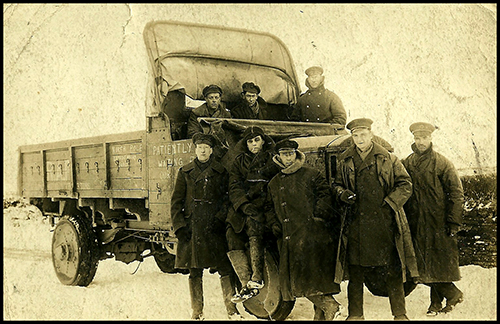 Life
as an SMTO
was a constant
juggling
act
when
the
Corps was
in
the line. Only
when
the
Corps
moved
into rest
was there
any respite.
I ANZAC
Corps
SMTO
was thirty
to forty
lorries short
of those
demanded every
day during
March 1917.
The SMTO
had to find the
shortfall
if
the
railhead was
to
be cleared without
delays.
At
this
time,
the
SMTO had
no control over Corps
HT units,
so was unable
to call
on surplus
HT
to supplement
MT.57
Life
as an SMTO
was a constant
juggling
act
when
the
Corps was
in
the line. Only
when
the
Corps
moved
into rest
was there
any respite.
I ANZAC
Corps
SMTO
was thirty
to forty
lorries short
of those
demanded every
day during
March 1917.
The SMTO
had to find the
shortfall
if
the
railhead was
to
be cleared without
delays.
At
this
time,
the
SMTO had
no control over Corps
HT units,
so was unable
to call
on surplus
HT
to supplement
MT.57
Lack of space and available manpower
prevented
storage at
railheads
and
lorries
were
loaded
directly
from
trains.
Thus,
when
only
twenty
lorries
were
available
for thirty
loads,
ten
lorries
were
required
to
do
two
journeys.
Those
doing second
journeys
had
to
load,
dump
just
outside
the
railhead
then return
to load
the
second.
After dumping
the
second
load at
the
refilling
point
they
had
to return
and
reload
the
first
load. Reducing
the
WE reduced
assets
but
not
workload.
ASPs
and
DSCs had
lorries
administered
by
them for maintenance,
record
keeping
etc
that
were
attached
to other
units. Most were
attached to
Royal
Engineers
[RE] Roads,
Signals
and
Tunnelling companies. General
Hospitals,
Field Ambulances
and Casualty
Clearing
Stations,
needed
MT
for collecting
supplies.
If a DSC or ASP
required
seventy-five
lorries
but
only
had fifty
serviceable,
twenty-five had
to be retrieved from
the
detached
ones, often from RE Roads
companies,
who were
large users of
MT.
The
result
was that
road
making and
repairs
were
either halted
or at
least
curtailed.
Roads
inevitably
deteriorated
and
MT
gained
a reputation
for destroying
the
roads
that
were
crucial
in
ensuring
continuity
of supply
and vital
for any planned
advance.
Roads offered
flexibility
impossible with
railways
and any
planned advance
was more reliant
on
the condition
of roads than
rails.
As vulnerable
to enemy
shells and
bombs as
the railways,
it
was possible to repair,
or
build
a new
road
around a
large shellhole
within
a few hours. Shelled
railways
were
often
out
of commission
for several
days. Lorries
identified
as ‘ROADS’
lorries
were
able
to
run contrary
to
traffic
flows and
use all roads,
irrespective
of whether
designated
for
troops,
HT or
MT.
Maintaining
a viable
road
transport
system
was vital
for supply and facilitate
army mobility.
Lorries
could divert
to different
railheads
or refilling
points
with
a single
message, whereas railways
remained
fixed. A train
with
thirty
trucks
that
derailed
or broke
down was thirty
trucks not
delivered
and
following
trains
delayed.
In a convoy of
thirty
lorries,
if one
broke
down
the
others simply
drove
around it
and only
a single
load was
delayed.
Blown
up
tracks
halted
trains
until
repaired,
with subsequent
trains
needing
diverting.
Lorry convoys simply
drove
around shellholes.
The
consequence
of
late
trains was considerable,
even without
considering
that
reserve
dumps
were
being reduced.
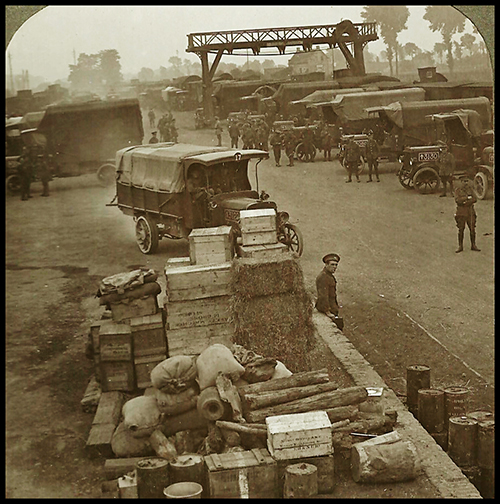
Railheads
were at
the edge
of towns
and
villages.
LR
sidings
were
simply
at
the roadside.
It
was essential
that
schedules
were
maintained
to avoid
gridlock around
the
railhead.
Fifty
lorries
filled
most
railheads as
they unloaded
trains.
There
was a set time
to
clear
each train so
that
lorries
were
clear of
the
area before
the
next
company
arrived
for
the
next
train. When a
train
was
late,
the
company
scheduled
to clear
the
following
train
arrived
before
the
first
had
departed.
They could
not
get
to
the
railhead
because the
first company
was still
there.
The first
company was delayed
leaving
because
the
second company
was
blocking
the
roads.
Equally,
if
the
ASC were
not available
to clear
the
train,
the next
would
arrive
before
the
first
train
could clear
the
railhead
or LR
siding.
Very quickly
the supply
line became
gridlocked.
Efficient
working
of railheads
was crucial
to
the
entire
system
from port
to
trench.
Lt
Col
CE McVittie,
I Corps,
SMTO
reports on the
workload
and difficulties that
I
Corps
transport
was experiencing.
“On 5 April 1917, Heavy Artillery
demanded 200
lorries.
The following
day
the First Army
demanded
150
lorries.
These
could only
be found
from
the
200
previously sent
to Heavy Artillery,
which
were
not
being
used because the
ammunition
had not arrived.
In the afternoon
a stone
train
arrived
at
Hersin
which required
23
lorries
and
these were obtained
from
the
50
still
with
Heavy
Artillery.
At
midnight
I Corps
HQ
telephoned
that
a stone
train
had arrived
without
warning
at
Houdain
and had
to
be cleared
immediately
as a further two
trains
were
arriving.
This
entailed
taking
20
lorries
from both
24 and
40 DSC. These
40
lorries
had already
done a full
day’s
work
and would
be needed
the
next
day. 80
drivers
were
woken
in
the
middle
of
the
night
to work
an extra shift.
The
following
day,
the
20
lorries
from
40 DSC were
still
working to clear
the
second
stone
train,
meaning 20
lorries
had to
be found
to
do
their
planned
work.
The
lorries
of 24 DSC had been
taken away
by
their
Division
to
do their
normal work and
needed to
be replaced
from somewhere.
At
a moment’s notice
40
lorries
had
to be found
from
somewhere
if
the
scheduled work was
to
be covered.
On the
8th,
Heavy Artillery
demanded
200
again
but
were
only given
150
as that
was all
that
was available.”58
For three
days
MT
worked
day and
night.
The 150
lorries
with
Heavy Artillery had
to
do
the
work
of the
200
demanded.
McVittie
highlighted three
days,
but
it could
have
been
any
three
days at
any
time
of any month.
Despite
his
earlier
reluctance
to accept
Geddes’ intervention,
Haig,
wrote on 8 April 1917
that
Major
General Sir
Eric
Geddes,
Director-General
of Transportation
“Has organised
the
Transportation Service
of the Army
with
great skill
and
success. He has designed
and made
a whole
network of
New
Railways
(a
broad
gauge and
narrow)
in rear
of the
front
without
which
any offensive operation
on the
present
scale
would
be
impossible;
and
by forethought, skill
and real
energy has enabled the armies
commanded
by
Generals
Gough and
Rawlinson
to follow
up
closely
the
retreating
Germans
both
during
and subsequent
to,
the Battle
of
the Ancre.
I recommend
him
for a KCB.”59
Not
a single
word
to acknowledge
that
road
transport
even
existed.
Geddes’
reforms
stopped
at
the
railway
terminus,
so there
was no reason Haig
should mention
the
roads
beyond
the end of
the
line.
Despite not
a single
man
in any
trench,
hospital
or headquarters office receiving
any food,
ammunition,
medicine,
fuel or
clothing
not
carried
on the roads
in front
of the railways.
Haig’s
praise
was
written
before
Geddes’
reorganisation was
fully
tested and
provides
a curious
contrast
to
the
ASC reports
of the
previous
few weeks. Haig
was
obviously
more acquainted with
the railway
operation
than
the roads
and had
been
open to change,
supporting
Geddes after seeing
the
benefits of his
reorganising.
It
is
clear
the
rail
and road
sections of
the
LoC
were
regarded
as two separate
entities rather
than an
interconnected
system.
On 1 July
1917, a conference
was
convened by QMG, at
Haig’s
request,
to
determine
the
scale
of reduction
of MT
on the Western
Front.
This
was after
Geddes reported
that
tonnage
carried
on
LR
had increased
from 24,000 tons
per
week
in
February
to 92,000
tons
per week currently.
Maj
R
Shelton,
DADT,
Second Army reported
that
there
had been
no
reduction
in
the use of MT.60
There
was an obvious
assumption
that
more
tonnage
on the
railways, meant
less for road
transport.
The
increased
use of LR only
moved the
railhead
nearer
to
the
refilling
point,
reduced
lorry
mileage
and sometimes
increased use of
HT.
Any reduction in
MT
was
impossible as it
was diverted
to the
RE and
for other
extraneous
duties.
Every additional
ton carried
by
the
railways
had
to
be
transferred
onto
roads for
the frontlines.
The extra
tonnage
was
due
to
the build-up
of materiel
for
the
Third
Battle
of Ypres,
and it would be surprising if the increased lines of LR did not carry
more.
By August
1917, the situation
had deteriorated
further.
The
strength
of LR was that
it
was
quick
and easy
to manufacture
and
lay.
Hundreds
of miles of
track were
laid,
implying
that
MT
could
be reduced.
The
speed
it
was
laid
was also
its
Achilles Heel.
Once the ground
became soft the
tracks sank
under
the weight
of
the
trains,
derailing
them.
Trains
did not
work well when
the rails
were
submerged
in mud.
Even on dry, hard ground
rails easily
distorted
and
derailments
were
commonplace.
On 3 August,
XIII Corps
SMTO
recorded
that
“after three
days
of rain, Light
Railway track
in very bad
condition. Unless steps
are
taken
to ballast the
line,
much additional
work
will
be
thrown
on the
lorries.”61
Despite
the
difficulties
with LR,
a census was conducted
by
the
Fifth
Army Deputy
Director
of
Supplies &
Transport
[DDS&T]62 at
the
DT’s
request.
This
was to
determine
the
extent
that
MT
could
be reduced as LR extended.
The DT
was only
doing
WO bidding,
although
it must
be remembered
that
the
WO had
a far broader perspective
than
the
‘local’
GHQ
in France.
None
of
Fifth Army’s MT
units could
lose
MT and
maintain
their
current workload.
The results
were
discussed
at
a conference
on 12
August. The Deputy
Director
of
Transport
[DDT] advised DDS&T
that
the
census was purely fact-finding
to
provide
the
WO and QMG with
up-to-date information
and
no reductions were
planned.
He also
pointed
out
that
every army
in France had
reported
the
same.63
With the
Battle of Third Ypres beginning, it is not clear how long the ‘up to date’
figures the WO wanted would be relevant.
Three
days
later,
the
DT
was summoned
to a conference by QMG
attended
by all the
top
brass from
London
and France.
The agenda
was to establish
where
reductions
in
MT
could be
made
in France. It was
nothing
more
than an
exercise
to
make
GHQ in
France feel
involved.
On 18 August,
the DT
was
again
summoned
to QMG’s office
and told
that
the
“Commander-in
Chief had
arranged to hold
a conference
on
the
20th with
a
view
to
ascertaining
from
what
sources men could best
be obtained
for replacing
casualties
in
the
Infantry.”64
The
decision
had
apparently
been made, probably
in
London,
before
the
first
conference
just one week earlier.
The
DT was
instructed
by QMG
to prepare
a statement
of men available if
Class “A” men
were replaced
by
Class
“B”
men leaving
a ratio
of
one
Class “B”
man to three
Class “A” men. Despite
the DT
arguing
that
it
would be
“dangerous
and
most
inadvisable
to attempt
to
train
drivers
with Units
in
the
field.”65
QMG
was adamant,
stating
the
decision had
been
made
by the
Commander-in-Chief.
The
result
was
that
3,061 men were made available from
ASC
MT
Coys, 4,791
from
Supply
Coys,
9,536 from
ASC
HT Coys
and 2,420 from
Royal
Artillery, making
19,808
in
total.66
The
road
section of
the
LoC
was stripped
of 19,808 skilled
men when it was under intense
pressure
and
had already
been
worn
down by months
of struggle.
ASC
MT Coys
were used
to
transferring
men between
units.
Since
1914 MT
had
been
transferred between
units
to homogenise marques as far as
possible.
Every
vehicle
transferred,
whether
to another
unit
or Heavy
Repair
Shop, had
to be
accompanied
by its
driver.
It
was an opportunity
to move
the
worst
drivers
and lorries
out of
the
unit.
Inevitably
units
receiving
lorries
from others received
the worst.
It
is
a common complaint
that
vehicles
received
were unroadworthy
and
drivers
very
poor.
Every
unit
complaining
about
the
poor quality
of vehicles
and
drivers
received, had
themselves
sent
the
same
to another
unit. It
had been known since
before
the
war
that
the more
skilled and experienced
drivers
achieved
the
best
fuel
consumption
and caused
the
least
wear and tear. It
is a
principle
that
still holds true
in
modern
transport
fleets.
The
ASC
considered
that
Class
“A” men were
the
most highly skilled
and as such were valuable
assets
to
be retained.
The
WO considered
they
had
earned
the
classification
by
being
the
best,
the
fittest,
strongest
and
most disciplined.
Attributes
the
WO wanted
for the
trenches.
The ASC
only
supplied
the means
to
wage
war, so could
make
do without
skilled men.
With
desperate
need
for petrol
economy, spare
parts
increasingly
difficult
to obtain
and
the
impending
preparations
for
the
Third
Battle of Ypres,
the
ASC
was
stripped
of
its
most skilled
and valuable
men,
replaced
by men needing
further
training.
The DT
recorded
on 27 June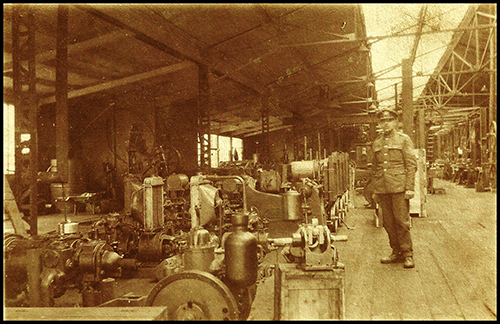
“I have
discussed
with
the Director
of
Supplies
and Transport,
WO,
that
the continued
shortage
of spare
parts, and
as a result
thereof
feel
confident that
the
serious
danger
resulting
from
ever
growing
shortage
will
never
be removed unless
a radical
change
is
made
in
the
Home allotment
of material
and manpower
for
the
production
of Mechanical
Transport
spare
parts.”67
The
Director
of
Munitions Requirements
and Statistics at
the
Ministry
of Munitions
gave his appraisal
of the
spare
parts position
on 14
August
“Many firms are
so busy
making new
vehicles
that
they find
it
impossible
to execute
large
orders for
spares;
e.g.
the makers
of Maudslay
cars [lorries]
have
a large
stock
of orders since March 1916
which
they
have
hardly
touched.
They say
quite
openly
that
they
would have
to stop
producing
new cars
if
they were
to execute
the stock
order
for spares.
The
priority
for spares
is
low, generally
4, occasionally 3 or
2
and
consequently
it
is
difficult
to obtain
the necessary materials.
Further, many
manufacturers
are busy doing
ammunition work
of high
priority,
e.g. aeroplanes
and tanks,
that
they are
unable
to
deliver
adequate
supplies
of Mechanical
Transport
spares.”68
The
Ministry
of Munitions
used a scale
of one
to five
for allocation
of raw materials priority.
Top
priority
was one,
reserved
for
the Admiralty
and aircraft
and
received
everything
demanded. Five
was the
lowest
and
only
received
the
leftovers.
MT
was rarely
higher priority
than four.
One
year previously
in June
1916, 358 Coy ASC (3 Heavy
Repair
Shop), St Omer
went
someway
to resolving
the
issue
of spare
parts
shortage
“Major Rose
went
to
Rouen for the purpose
of cancelling
outstanding
demands
made
before December
31st 1915
and
going
into
the
question
of the supply
of stores.”69
Lt
Col
Blamey,
IX
Corps,
SMTO
records
in some
detail
the
workload
in September
1917
during
these
reductions. Heavy and Field
Ammunition demanded
2,100
LR
wagons,
with
only
1,746 available,
leaving
a shortfall
of 3,540
tons of ammunition.
RE stores
demanded 2,127 wagons with only
926
available,
a shortfall of 12,010
tons.
The
total
shortfall
of 15,550
tons
needed
5,184
lorry
journeys in
addition
to
the
normal
work,
assuming 3-ton lorries
were
used to
capacity.70
Corps
MT was also
called
upon
to convey
49,000
troops
to the
battlefields,
making
a further
1,960
lorry
journeys.
Every one
of IX Corps approximate
1,000
lorries had
to complete
seven extra
shifts
in
addition
to
their
normal
work
during
the month.
Every
lorry
in
the Corps
had to
work for
thirty-seven
of the
available
thirty
days.
In reality,
the
extra
shifts
were
more
with 30%
of the
Corps MT unserviceable
through
being
overworked.71
October’s
workload
was
the
same, prompting Blamey
to record
“Light Railway Trucks
demanded
and
supplied for ammunition
and
RE
work shows
a deficiency
of 50%
to
those demanded;
it will
be remembered
that
a similar
deficiency was reported
last
month.”72
That
he felt
the
need
to
draw
attention
to
his
previous
month’s
appraisal, suggests he felt
nothing
was
being
done
to resolve
the
overworking problem.
He was however,
only seeing
the
situation
from his own position
without
the
wider
context.
It
is
an indication
that
the frustration
he
vented
in
November
1918
was already
festering.
On 31
December 1917,
the
Commander-in-Chief, Field
Marshal Sir Douglas
Haig
informed
the
WO, with
letter
No. 6712(Q.A1)
of his
intention
to extend
the
system of
pooling recommended earlier
by the
Army Council.73 January
and February
1918
were
spent
further
reorganising
to create
GHQ
Reserve
MT
Coys74 by
consolidating
existing
companies.
Haig
recognised
the
flexibility
of road transport
and
that
any rationalisation was
in effect
reduction.
He also
knew that a static army needed
less
resources
than a mobile
army.
Reduction
always
resulted
in assets
surplus
to
establishment
which
would
be returned
to
England, or scrapped in France and
not replaced from England.
Haig
therefore
created
GHQ
Reserve Companies
from
the
surplus,
keeping
them
in
France.
He
would
also
have
been acutely
aware of
the
performance
of
the LR
at Passchendaele, recorded
by
the
QMG
in
his
report
of 1914-18
“The experience
of
Passchendaele
shewed
the vulnerability
of light
railways
under
intensive
fire.
The
amazing accuracy
of
the
enemy artillery fire,
concentrated on the
roads and railway systems
in rear
of the
fighting
formations,
practically
immobilised
the
light
railways. With
the
tracks cut
in
all
directions,
the
trains
were
targets
for the
enemy, and were utterly unable
to cope
with
the
immense
volume of ammunition,
engineering stores
and supplies
required
by
the
troops.
But
for the
fine
work
of Mechanical
Transport,
the
situation
would
have resulted
in
disaster
instead
of victory.”75
This
failure
caused
LR
to come
under close
scrutiny
by
GHQ.
The
decision
was made,
based
partly on
the
shortage
of raw materials,
but
mainly
on the
anticipated
impending
German offensive to
begin
the
removal
of
LR.
By March 1918,
the
Fifth
Army
area was almost devoid
of
its
LR.
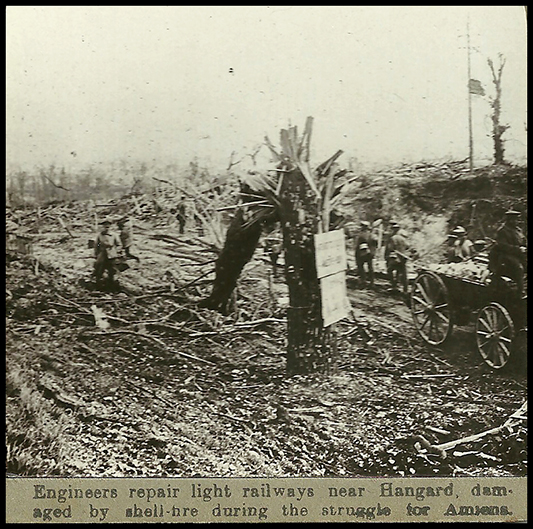
“The correctness
of this
policy
was shewn
when the
Fourth
and Fifth
Army
areas
were
overrun. Stocks had not
merely
to be withdrawn
but
to
be
demolished,
so
extensive
was our retirement.
Once
again Mechanical
Transport
saved the
armies.”76
The
reorganising
involved
the
renaming of
MT
Coys.
HQ
Corps MT
Columns
were
formed
by merging
HQ
Corps
Ammunition
Parks
with
HQ
Corps
Supply Columns. Divisional
MT
Coys were formed by merging
ASPs
with
DSCs.
The
most
important
change
was
that
all
the
Corps
MT and
HT
came under a Central
Controller.
Previously
MT had
been wasted
by
Siege Parks, Brigades
and Batteries
having
lorries
permanently
attached.
Transport was used
indiscriminately
simply because they were
the
unit
asset. The
Central
Controller
was able
to
allocate
MT
or
HT
entirely
by requirement.
Corps
road
transport
was
thus reduced
to
the
minimum without
any
loss of capability.77
This
theory held
good
with
the
frontline
relatively
static and
LR able
to operate.
When the BEF
arrived
in France,
the
ASC
had
little
experience
of MT.
Lessons learned had
been
in
the
field and were
inevitably
almost
entirely
driven
by
the
needs
of the static
situation.
Although
the
back area
was a hive
of activity,
the static
frontline
allowed
for fixed
railheads
and supply
lines.
Every officer,
except
the
very few
with
the BEF
in 1914,
no matter
how skilled,
had
no experience
of mobile
warfare!
When
the
German Spring
Offensive
commenced on 21 March 1918,
the fragility
of
the
LoC, evolved
for static
warfare and heavily
reliant
on
the railways,
was
quickly
exposed.
LR
had allowed
the
merging
of ammunition
and
supply
companies into
Divisional
MT
[DMT]
Companies.
Immediately
the
frontline
became
mobile,
the
railways
became
ineffective
due
to constant
changes of railhead
and
destruction
of
the
tracks. The
DMT Coys
had
to be
divided
into
two separate
units again as different
railheads were allocated
for supplies
and ammunition.
LR had
also been dismantled.
This
made
administration
of the
companies
difficult
and
their
entire establishment
was
needed
for railhead
work.
There
was no
surplus MT
available
for
walking
wounded
or salving
the
vast
quantities
of ordnance and other stores.78
SMTOs
were
critical
of the
changes,
showing
they
were
understandably
too engrossed with
their
own work
to appreciate
the agility
of the system
now able react
to
unforeseen
circumstances.
It needed
only a message
to
divert
MT from scheduled
work
to where
they were
needed
most.
Lorries
waiting
for
walking wounded,
simply
went
elsewhere
and
lorries
returning
from refilling
points
diverted
to return
with
walking
wounded
or salvage.
The
German offensive
forced
the
LoC to
respond quickly
to
constantly
changing
conditions.
Initially,
supply lorries
were
able to clear
their
railheads
after
completing
a day working on extraneous
duties.
The
lengthening
distances
between
railhead and refilling
point
and
increasingly
congested roads
made anything
other
than
supply work
impossible.
The value of Haig’s
foresight
in creating
GHQ
Reserve
Companies
was soon
obvious.
As a
GHQ asset
they
could be allocated
to
plug
gaps
irrespective
of area or
role.
The
extra
workload
inevitably
caused additional
wear
and establishments
began
to reduce as
vehicles
became
unserviceable.
Although
every MT company
had
mobile
workshops,
they
took
too
long
to move
to be
useable as companies
changed
base
almost
daily.
They
never
had
the chance
to
carry out repairs.
The
situation
was considerably
worsened
when 358
Coy
ASC
(3 Heavy
Repair
Shop)
was ordered
to evacuate
their
Saint-Omer
workshops
on 13 April,
cutting
off the supply
of repaired
vehicles
from
that
source.79
In addition
to
these
difficulties,
when
telephone
communications
broke
down
the only
available
contact
was via a motorcycle
despatch rider,
of which only one
was
permitted
per MT
unit.
MT
units
had to
keep
in contact
with
both
their
Division
and with
Corps HQ,
either
of which
could move at
any
time,
often
while
the messenger
was mid-journey.
Lt
Col
GH Harvey, XV Corps,
SMTO
recorded
“The difficulty
of intercommunication
was accentuated
when ammunition ceased
to
be allotted
by
the
Corps.
It
now became necessary for
units
to keep
in
touch not
only
with Corps HQ
and their
Divisions
and
Trains
but
also with
their
Royal Artillery,
and on more
than one occasion
misunderstandings
arose which would
have been
obviated
had
greater
facilities
existed
for transmitting
messages.”80
The
Germans
destroyed
as much of
the
rail and
road
infrastructure
as possible
during
their
retreat
from August.
Whereas railways
took weeks
to rebuild, roads
could
quickly
be made useable
again.
Both Mechanical and Horse
Transport
were
flexible
enough
to negotiate bad surfaces.
The
speed of advance
of the
BEF
and
the
destruction
of
the
railways
by
the
retreating
Germans very quickly meant
the frontline
was forty
miles ahead of the
nearest
railhead.
Long distances
over poor
roads
and shortage of spare
parts
were
a heavy burden after
nearly
two years
of struggle.
The
DT
wrote
to
the
QMG
“I should like
to
bring
to your notice
the
rise
in
the
number
of
lorries
undergoing,
or
awaiting,
repair
in the
Armies.
For the week ending
October 5th
2,606
lorries
are off
the
road, of which
455
were
awaiting
spare
parts, while
for the week ending
October
19th 3,125
lorries
were off
the
road, of which 582
were awaiting spare
parts.
Bad
surface
of
the
roads,
causing
excessive
number of road
spring
failures.
In the IX
Corps alone,
71 of 224
immobile
lorries
needed
road
spring
repairs.
30
tons of spring
steel
have been obtained
through
the
French Authorities
in
Paris,
while supplies
from
England
have been
urged to
the
utmost, but
are
not
forthcoming.
Great
distances
must
be traversed,
in
some
cases Battery
positions being as much as
40 miles from railhead.”81
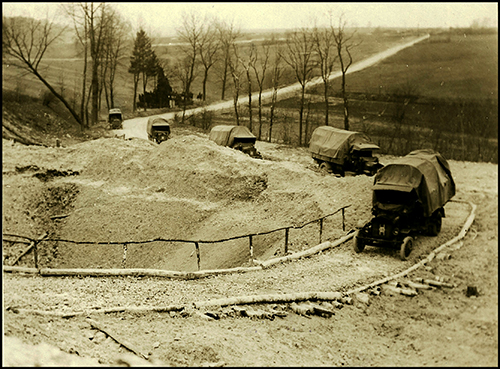 Railheads
changed
constantly
and refilling
points
became mobile,
often
transport
only
had
a rough
idea where
to find
their
refilling
point.
Forty
miles
today
is
insignificant, but
in 1918
was a minimum
ten
hour’s duration. MT
was
working
with one
driver
resting
while
the
other
drove allowing
the
lorry to run
for
twenty-four
hours per day.
Heavy rain at
the beginning
of November
made the
roads even worse
and to add
to
the
problems,
32 DMT
Coy recorded
that
30%
of
their
drivers
were unavailable for
work
due
to
the
influenza
epidemic.82
Railheads
changed
constantly
and refilling
points
became mobile,
often
transport
only
had
a rough
idea where
to find
their
refilling
point.
Forty
miles
today
is
insignificant, but
in 1918
was a minimum
ten
hour’s duration. MT
was
working
with one
driver
resting
while
the
other
drove allowing
the
lorry to run
for
twenty-four
hours per day.
Heavy rain at
the beginning
of November
made the
roads even worse
and to add
to
the
problems,
32 DMT
Coy recorded
that
30%
of
their
drivers
were unavailable for
work
due
to
the
influenza
epidemic.82
As usual,
when
companies
were
busy,
the
diaries
become very
brief
and details
are scant
between
April
and November
1918.
XV Corps provide
a retrospective
account from May
to October.
As a
daily
average, XV Corps
had 630
lorries
on establishment,
of which
125
were in
workshops
and
475
used.
From
May
to July,
the
lorries
travelled
1,688,423
miles
which
cost,
without
wages or
road repairs,
£200,000
[£9,919,800
in 2025].
Total mileage
during
the
six
months
from May
was 3,138,561
miles.83
On 21
September, Fourth
Army notified
that
evacuated
vehicles
would
be struck
off
the
strength
at
York Road
Evacuation
Park,
Peronne
and not on arrival
at
a
Heavy
Repair
Shop. Until
evacuated vehicles
were
struck off, no
replacements could
be
demanded.
It
made no
difference
as no replacements
were available
and hostilities
ended before demands
were met.
It
only
illustrates
Fourth
Army
acknowledging
the
collapse
of the railways.84
ASC
MT mobilised
in 1914
with
almost
no assets and even
less experience.
After
the
initial
chaos, growth
was piecemeal
and
parallel to
the BEF
expansion.
New
units
were formed as men and
machines
became available and
attached
to new divisions
as they
were
formed.
As
the workload
grew,
so did
the ASC
and the
BEF received
its supplies.
The
Battle of
the
Somme
provided
a severe
test
with
the
massive
increase
in munitions, food
and
medical
supplies
as the
battle
escalated
and continued
longer
than
expected.
ASC MT
coped, though
was close to
breaking
point.
The men were
exhausted,
MT worked
to a
standstill
but
there
was pride, in
France anyway,
that
they had
coped.
Lloyd
George,
who
had
been Minister
of Munitions
since May
1915
knew of
the
impending
increase
in
munitions production.
Eric
Geddes,
formerly Director
of Supply,
the
same. Both
witnessed
the
LoC
brought almost
to
its
knees
and
it
was
obvious
that
changes would
be needed.
Geddes’
experience
as General Manager
of
the
North
Eastern
Railway, made
him
ideal
candidate
to
reorganise
the railways,
particularly
as
the
static
frontline
made
the
railways
similar
to
civilian
networks with fixed routes
and railheads.
The
roads
in front
of
the railways
were
the WO’s
responsibility
and while
road
and
rail
had
to
dovetail
together,
they remained
independent.
Centralising control
of MT
gave
flexibility
to asset
management
and allowed reductions
in men
and
machines.
No organisation likes
change, especially
when
their assets
are reduced
and
the
ASC responded
with
criticism
of both
WO and railways
at every opportunity.
The
German Spring
Offensive and
subsequent retreat
proved
the
inflexibility
of railways.
Railways
were
unable
to cope
with
changing
railheads
caused
by
mobile
armies. Damaged
tracks
took
days to
repair,
roads
only a
matter
of hours. Trains were
unable
to
divert
around
broken
tracks leaving
them
stranded.
Lorry convoys
simply
drove around obstacles.
By
the
Armistice
the
frontline
had advanced
to
be
at
least
forty miles
ahead of railheads.
MT
had to
take
on the
work of
the railways
to keep
the advancing
army supplied.
LR
failed to
meet
its
expected
potential.
Hastily
laid
tracks over
ill-prepared
ground
quickly
distorted
causing
numerous derailments.
Soft
ground
after rain
could
not
support
the weight
of trains
and
they sank, rendering
them useless.
Each failure
created additional
burden
on road
transport,
particularly
during
the
Third
Battle
of Ypres.
Two
years of
reorganising,
increasing
the
railways,
decreasing
ASC
assets had
ended
with
the
army at
a standstill,
waiting for
the
LoC
to catch
up.
That
was the
frustration
that
Lt
Col Blamey
felt
the
need
to
vent
that
began
this
article.
King George V awarded the Army Service Corps the Royal prefix on 27
November 1918 and the Royal Army Service Corps came into being.
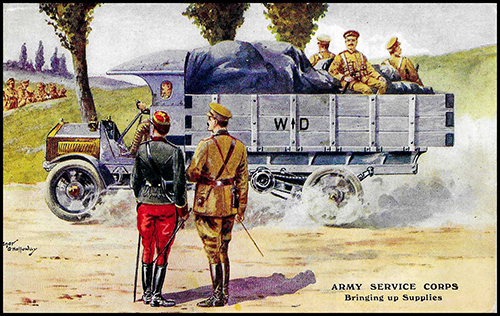
References
1 The
National
Archives,
WO
95/846
-
War
Diary,
IX
Corps
SMTO,
19/11/1918
2 Senior
Mechanical
Transport Officer
–
Officer
in
command of
all
the
mechanical
transport
in
individual
corps. Has
no
authority
over
corps
horse
transport.
3 Line
of
Communication
– Route
for
supplies
and
reinforcements
from
a
port
of
entry
to
the
frontline
troops,
serviced
by
both
road and
rail.
4 Army
Service
Corps
–
The
supply
line
of
the
army
responsible
for
delivering supplies from
railhead
to
frontline, vehicle maintenance
and
bakeries
etc.
using both
mechanical
and
animal
transport.
5 Supply
Railhead
–
The
terminus
of
the
standard
gauge
railway
where
supplies
were
transferred
to
mechanical
transport.
6 Divisional
Supply
Column
–
Supply
companies
of
the
ASC
using
MT
to operate
between
railhead
and
horse
transport on
the
LoC.
7 Refilling
Point
–
A
dump
at
the
roadside
where
MT transferred
supplies
to
horse
transport
for
onward
transmission
to
the
frontline.
8 Mechanical
Transport
–
Every
type
of
motorised
road-going
vehicle.
All
the
MT,
except
those
of
the
RFC
were
assets
of
the
ASC
and
often
detached
to
Royal
Engineers,
medical services,
artillery,
etc.
9 Divisional
Train
–
Supply
companies
operated
by
the
ASC
using horse transport.
10 Royal
Logistic
Corps
Museum,
B2,
8859
–
The
Military
Effort
and
Growth
of
the
Army
Service
Corps
During the
War
1914-1918.
11 ibid
12 Subsidy
Scheme
–
A
scheme
that
paid a subsidy
to
lorry
owners
to
assist
the
initial purchase
with annual
maintenance
payments
on
condition
that
the vehicle
was
available
to
the
army
if
needed.
Drivers
of
subsidy
lorries
had
to
enlist
into
the Territorial
Force/Army.
13 TNA,
T1/11425
–
Motor
Transport
Vehicles Subsidy
Arrangements
Pending
New
Scheme,
23/8/1911.
14 Royal
Logistic
Corps
Museum,
B2,
8859
–
The
Military
Effort
and
Growth
of
the
Army
Service
Corps
During the
War
1914-1918.
15 Ammunition
Park
–
ASC transport for
the carriage of ammunition. Sometimes an administerial office controlling
ASPs, sometimes operating their own transport.
16 The
National
Archives,
WO
95/130
–
War
Diary,
62
Coy
ASC
(2
Division
Ammunition Park),
5-8/8/1914.
17 TNA,
WO
107/18
–
New
Armies
1914-15, Mechanical
Transport,
3/9/1914.
18 Director
of Transport
– Controller
of
all
road
transport
of
the
BEF
based
at
GHQ
in
France.
19 TNA,
WO
95/71
–
War
Diary,
Director
of
Transport,
5/12/1914.
20 TNA,
WO
95/202
–
War Diary, Deputy Director
of
Supplies
& Transport,
18/9/1915.
21 Ammunition
Sub
Park
–
ASC MT ammunition transport
company, sometimes administered by an Ammunition Park.
22 Motor
Ambulance
Convoy
–
Unit
of
50
motor
ambulances
operated
by
the
ASC
but
with
a
Medical
Corps
commanding
officer to
comply
with
Hague
Convention
terms
for
non-combatant
units.
23 TNA,
WO
95/778
–
War
Diary,
VI
Corps,
A&QMG,
15/9/1916.
24 Sir
Eric
Geddes
–
General
Manager
of
North
Eastern
Railways
from
1911,
Director
of
Supply,
June
1916
and
Director-General
of
Transportation
from
October
1916.
Had
gained
experience
building light
railways
in
India
from
1895.
25 TNA,
WO
32/5163
–
Services
of
Eric
Geddes
in
Connection with
Transport
Arrangements, 1/8/1916.
26 Ibid,
4/8/1916.
27 TNA,
WO
32/5164
–
Transport
Arrangements
at
Home
and Overseas
Investigation
by Sir
Eric
Geddes,
16/8/1916.
28 TNA,
CAB
24/6/41
–
War
Cabinet,
2/2/1917.
29 TNA
CAB
24/2/41 – Our
Financial
Position
in America,
Committee
of
Imperial
Defence,
November
1916.
30 Bank
of
England
historical
exchange
rate
of $4.76/£1.00
and
inflation
calculator.
31 TNA
CAB
24/2/41 – Our
Financial
Position
in America,
Committee
of
Imperial
Defence,
November
1916.
32 Deputy
Assistant
Director
of Transport
–
The
Assistant
Director
of
Transport
is
the
DT
of
an
army
with
the
Deputy
being
his
second-in-command.
33 TNA,
WO
95/537
–
War
Diary,
Deputy
Assistant
Director
of
Transport,
Fifth
Army,
13/3/1917.
34 TNA,
MUN
5/5303
–
Halley Industrial
Motors,
19/5/1916.
35 ibid
36 TNA,
WO
95/71
–
War
Diary,
Director
of
Transport,
10/1/1917.
37 TNA,
WO
95/931
–
War
Diary,
XV
Corps,
SMTO,
sheet
1.
38 Ibid,
sheet
3.
39 TNA,
WO
95/829
–
War
Diary,
VIII
Corps,
SMTO,
5/5/1917.
40 War
Establishment
–
The
total number
of
assets
permitted
by
the
War
Office
in
each
company.
The
Establishment
was determined
by
the
size of
role
of
each
individual
company
and
MT
Coy
establishments
allowed
for
25%
additional
spare
vehicles to
allow
for
unserviceable
MT.
41 Corps
Reserve
Unit
– MT
unit intended
to be
kept
in
reserve
in
the
corps
to
accommodate
emergencies
and
not
to
be
used
as
spare
transport.
42 TNA,
WO
95/71
–
War
Diary,
Director
of
Transport,
2/2/1917.
43 TNA,
WO
95/931
–
War
Diary,
XV
Corps,
SMTO,
sheet
4.
44 Ibid, sheet 5
45 Ibid,
sheet
4-5.
46 TNA,
WO
95/71
–
War
Diary,
Director
of
Transport,
25/2/1917.
47 TNA,
WO
95/948
–
War
Diary,
XVII
Corps, SMTO,
1-31/3/1917.
48 TNA,
WO
95/957
–
War
Diary,
XVIII
Corps,
SMTO,
5/3/1917.
49 TNA,
WO
95/817
–
War
Diary,
VII
Corps,
SMTO,
correspondence
to HQ,
17/3/1917.
50 TNA,
WO
95/948
–
War
Diary,
XVII
CTSC,
17/3/1917.
51 TNA,
WO
95/957
–
War
Diary,
XVIII
Corps,
SMTO,
23/3/1917.
52 TNA,
WO
95/71
–
War
Diary,
Director
of
Transport,
23/3/1917.
53 RSO
-
Railway
Supply
Officer,
responsible for
all
supplies
on
the
railways,
checking, labelling and
liaison
between
receiving and
despatching formations.
54 RTO
-
Railway
Traffic
Officer,
formerly
Railway
Transport
Officer,
responsible
for
controlling
all
the
traffic
movements
on
the
railways.
55 TNA,
WO
95/794
–
War
Diary,
VI
Corps,
SMTO,
28/3/1917.
56 TNA,
WO
95/830
–
War
Diary,
23
Divisional
Supply
Column,
4/2/1917.
57 TNA,
WO
94/1017
–
War Diary,
1
ANZAC
Corps,
SMTO,
March Appendix
8.
58 TNA,
WO
95/625
–
War
Diary,
I
Corps,
SMTO,
5-8/4/1917.
59 TNA,
WO
339/139022
-
Service
Record,
Sir
Eric
Geddes,
8/4/1917.
60 TNA,
95/292
– War Diary,
Deputy
Assistant
Director
of
Transport, Second
Army,
11/7/1917.
61 TNA,
WO
95/907
–
War
Diary,
XIII
Corps,
SMTO,
3/8/1917.
62 Director
of
Supplies
& Transport
–
Controller
of
Supplies
&
Transport
for
the
BEF,
based
at
GHQ.
The
Deputy
Director of
Supplies
&
Transport fulfilled
the
same
role
within
each
individual
army.
63 TNA,
WO
95/537
–
War
Diary,
Deputy
Director
of
Supplies
&
Transport,
Fifth
Army,
12/8/1917.
64 TNA,
WO
95/71
–
War
Diary,
Director
of
Transport,
15/8/1917.
65 ibid
66 Ibid,
19/8/1917.
67 TNA,
WO
95/71
–
War
Diary,
Director
of
Transport,
27/5/1917.
68 TNA,
MUN
4/3103
–
(Mechanical
Transport)
Parts
for
Motors,
14/8/1917.
69 TNA,
WO
95/4167
–
War
Diary,
3
Heavy Repair
Shop
–
15/6/1916.
70 TNA,
WO
95/846
–
War
Diary,
IX
Corps,
SMTO,
30/9/1917,
September appendix
1.
71 ibid
72 TNA,
WO
95/846
–
War
Diary,
IX
Corps,
SMTO,
31/10/1917,
October
appendix
1.
73 TNA,
WO
95/71
–
War
Diary,
Director
of
Transport,
28/2/1918.
74 GHQ
Reserve
Coys
–
Units
created
for sole
use
of
the
Corps
to
be
diverted
to
wherever
the
need
for
extra
transport
was
needed.
75 TNA,
WO
107/69
–
Report
upon
the
Work
of
the
Quartermaster-General’s
Branch
of
the
Staff
and
Directorates
Controlled.
British Armies
in
France
and
Flanders
1914 –
1918.
76 ibid
77 TNA,
WO
95/846
–
War
Diary IX
Corps,
SMTO,
31/1/1918,
January
1918
appendix.
78 TNA,
WO,
95/817
–
War
Diary,
VII
Corps,
SMTO,
15/4/1918
appendix.
79 TNA,
WO
95/4167
–
War
Diary,
3
Heavy
repair
Shop,
13/4/1918.
80 TNA,
WO
95/931
–
War
Diary,
XV
Corps,
SMTO,
notes
on
MT,
April
1918
appendix.
81 TNA,
WO
95/71
–
War
Diary,
Director
of
Transport,
October
1918
appendix.
82 TNA
WO
95/848
–
War
Diary,
32 Divisional
MT
Coy,
5/11/1918.
83 TNA
WO
95/931
–
War
Diary
XV Corps
SMTO,
appendix.
84 TNA
WO
95/846
–
War
Diary,
IX Corps,
SMTO, 21/9/1918.